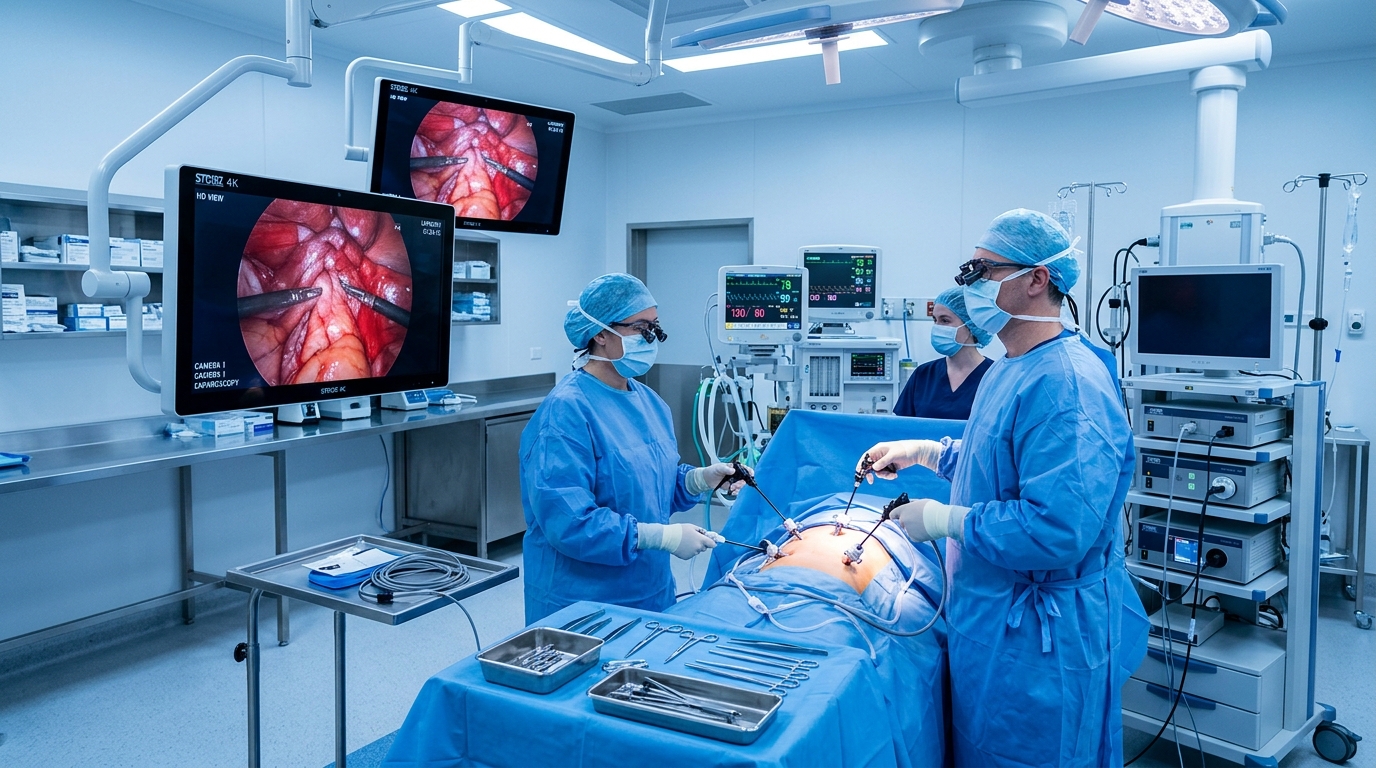
What is Laparoscopic Gynecological Surgery?
Laparoscopic Gynecological Surgery, often referred to as keyhole surgery or minimally invasive surgery (MIS), has transformed modern women’s healthcare. Instead of creating a large 10–15 cm open abdominal incision, the surgeon operates through 2 to 4 tiny incisions (each measuring just 0.5 to 1 cm).
A high-definition fiber-optic camera (laparoscope) provides magnified 3D visualization of the pelvic organs—uterus, ovaries, fallopian tubes, and pelvic peritoneum—allowing ultra-precise surgical execution with minimal tissue trauma.
Learn more under our dedicated Laparoscopic Surgery Services.
Key Benefits Over Traditional Open Surgery
| Factor | Laparoscopic (Keyhole) Surgery | Traditional Open Laparotomy |
|---|---|---|
| Incision Size | 2–4 tiny cuts (5–10 mm each) | 1 large abdominal cut (10–15 cm) |
| Post-Operative Pain | Significantly reduced, minimal analgesics | Moderate to severe wound pain |
| Blood Loss | Minimal (cauterization & magnified view) | Greater blood loss risk |
| Hospital Stay | 24 to 48 hours | 4 to 6 days |
| Recovery Period | 1 to 2 weeks back to desk work | 6 to 8 weeks |
| Infection Risk | Extremely low | Higher risk of wound breakdown |
| Cosmetic Scars | Near-invisible tiny marks | Prominent linear abdominal scar |
Common Gynecological Procedures Performed Laparoscopically
1. Total Laparoscopic Hysterectomy (TLH)
Removal of the uterus (with or without ovaries/tubes) for conditions such as large uterine fibroids, severe adenomyosis, abnormal uterine bleeding unresponsive to medicine, or endometrial hyperplasia.
2. Laparoscopic Ovarian Cystectomy
Precise excision of benign ovarian cysts (dermoid cysts, serous cystadenomas) and endometriomas (chocolate cysts) while preserving healthy ovarian cortex and future egg reserves.
3. Laparoscopic Myomectomy (Fibroid Removal)
Surgical removal of symptomatic uterine fibroids causing pelvic pressure, heavy menstrual cycles, or subfertility, while keeping the uterus intact for future pregnancies.
4. Laparoscopic Surgery for Endometriosis
Excision and ablation of deep infiltrating endometriosis nodules, release of pelvic adhesions, and restoration of normal pelvic anatomy. Read our dedicated guide on Endometriosis Treatment.
5. Ectopic Pregnancy Management
Emergency laparoscopic removal of tubal ectopic pregnancies to prevent life-threatening intra-abdominal hemorrhage while preserving the opposite tube.
Expected Recovery Timeline Following Laparoscopy
- Day 1 (Surgery Day): Sit up and take light sips of water. Gentle walking initiated within 6–8 hours to prevent blood clots.
- Day 2 (Discharge): Most patients tolerate normal soft meals and are discharged home comfortably.
- Week 1: Light indoor walking and gradual resumption of normal diet.
- Week 2: Resumption of routine desk work and light household chores.
- Week 4–6: Full clearance for strenuous workouts, gym training, and heavy lifting.
Frequently Asked Questions (FAQs)
Yes. Laparoscopic surgery is performed safely under general anesthesia so that the patient is asleep, pain-free, and the abdominal muscles are completely relaxed.
Medical-grade CO2 is gently infused to inflate the abdominal cavity, creating a clear working space and unobstructed view of the pelvic organs. The gas is released at the end of the procedure.
The incisions are typically less than 1 cm and are closed using subcuticular dissolvable sutures, leaving faint, barely visible marks that fade with time.

Dr. Honey Gemavat
Senior Obstetrician, Gynecologist & Laparoscopic Surgeon operating at tertiary surgical centers including SRV Hospital and Sanjeevani Hospital in Mumbai.